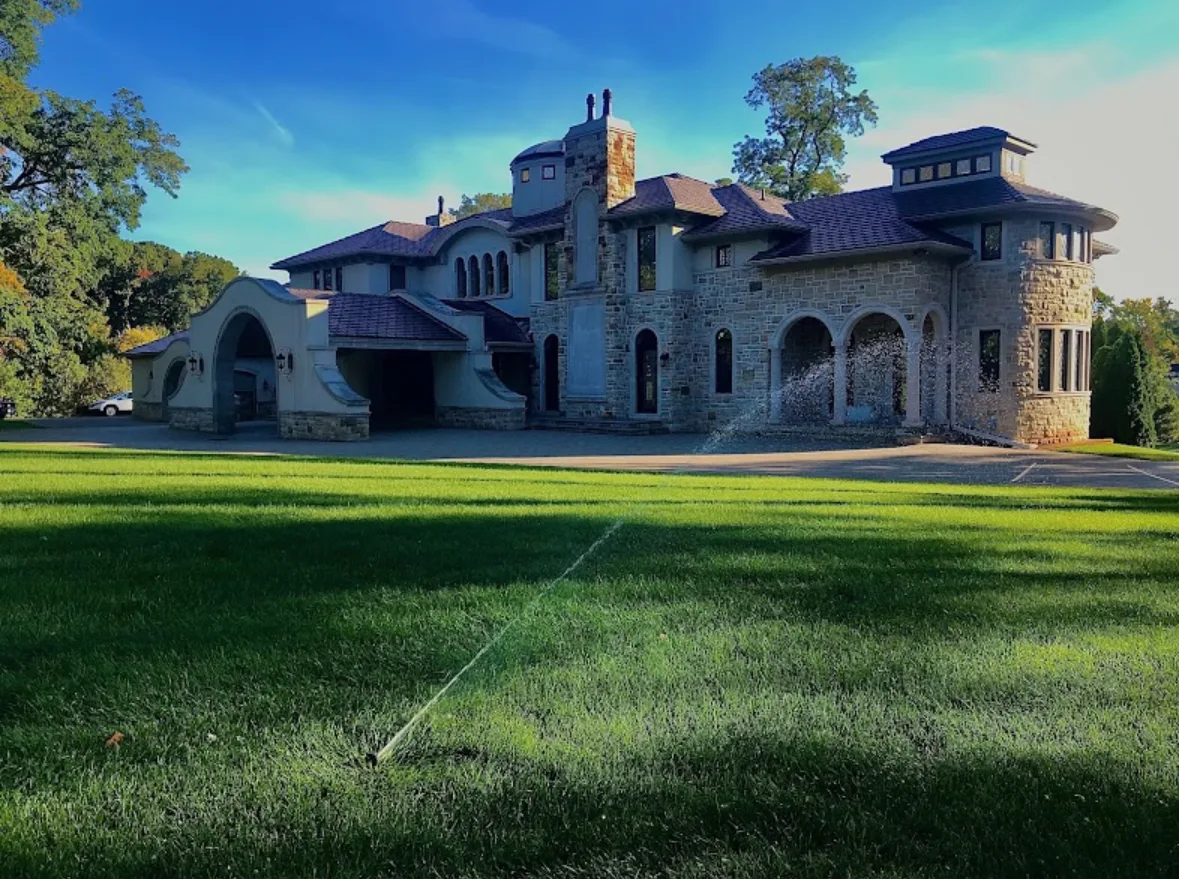
Sprinkler Installation & Repair in Franklin, MI
The One Oakland County Village With No Municipal Water
Franklin Village is a 2.66-square-mile historic enclave — the first designated historic district in Michigan (1969) — with roughly 3,100 residents, estate-scale lots that routinely cross three acres, and one infrastructure fact that makes every irrigation job here fundamentally different from the surrounding cities: **Franklin has no municipal water system.** Every property in the village draws from a private well. Not "some properties" — every property. A sprinkler contractor who quotes a Franklin job the same way they'd quote a Farmington Hills job across 14 Mile Road has just misunderstood the project.
That single fact cascades through every design decision. Well capacity — typically 5 to 15 gallons per minute on residential wells — sets a hard upper limit on how many heads can run simultaneously. Oakland County well water here carries 15 to 25 grains of hardness plus iron, which stains hardscape, clogs micro-spray emitters, and shortens head life. Backflow prevention is regulated as protection of the homeowner's own drinking supply, not the municipal main. None of that applies to the GLWA-fed cities around Franklin.
Well Capacity, Pump Coordination, and Iron Treatment
The first number on a Franklin sprinkler install quote is well yield. We pull the well report (or pressure-test the pressure tank and pump cycle) before drafting zones, because a 6-zone system running 10 GPM per zone will outrun a small well in minutes and collapse pressure mid-cycle. The fix is almost never "more zones" — it's fewer, smaller zones on longer scheduled cycles, with Hunter FX-series or Rain Bird R-VAN rotary nozzles tuned for low flow rates rather than broad-throw rotors. Smart controllers run cycle-and-soak intervals timed to pump recovery.
Well chemistry is the second variable. A Franklin system benefits from inline iron filtration ahead of the manifold, especially on properties with high iron content that would otherwise stain brick driveways and the historic stone walls the village is known for. Drip emitter zones in Franklin's naturalized buffer areas need finer filtration than municipal-water drip systems do — even 200-mesh filters at the zone valve are standard practice here. These aren't upcharges; they're what a Franklin system actually needs to last.
Estate Lots, 100-Year Canopy, and the Franklin Rouge Corridor
Franklin's estate character is genuine — at least 20 documented lots sit above three acres, and the "classic Franklin" home runs 2,500 to 5,000+ square feet on heavily wooded parcels established before most of Oakland County was subdivided. The Rouge River runs through the east side of the village and crosses under Franklin Road; the Franklin Cider Mill (1837, just over the line in Bloomfield Township, powered by a 90-ton press off the Rouge's original water wheel) is the Landscape reference point. Drip irrigation in naturalized buffer zones, rotors across open turf, and drip-on-a-timer in the historic perennial beds are the standard mix.
Franklin's aesthetic standards are governed by the Historic District Commission and the Franklin Community Association. There are no large HOAs in the Novi sense — it's a single village-wide set of standards, and visible hardware placement matters. We set heads flush, we route manifolds where they can't be seen from Franklin Road, and we document the install so an HDC review can reference it.
Winterizing Well-Fed Systems and the 2020 PFAS Context
Fall blowouts in Franklin run a different procedure than our GLWA-city work because we're blowing out from the well side: the compressor has to clear the pump-to-manifold supply line as well as the zones, and any pond or stream pump intakes need disconnect and drain-down before the first freeze. Drip emitter zones get a lower-pressure, longer-duration blow cycle to avoid blowing the emitter seats out. We book Franklin winterization early — September into early October — because the village's mature canopy holds snow early and the freeze window closes sooner than the inner-ring suburbs.
For context on water quality: the village passed a "safe water" resolution in September 2020 after Michigan PFAS sampling. Residential wells in Franklin tested non-detect, but one monitoring well near the groundwater-surface-water interface registered 64 ppt PFOS, exceeding EGLE criteria. Homeowners with whole-house PFAS filtration have additional considerations at the backflow preventer. If your Franklin property falls in that profile, tell us on the quote call and we'll route the install to protect both the filter and the irrigation system.
Schedule Service in Franklin
Call (586) 498-6112 or request a free quote online. We serve all of Franklin and surrounding Oakland County communities.
Find Elite Sprinkler Systems
Serving Franklin and surrounding Oakland County communities from our Ferndale, MI location.